
Peppol BIS Billing 3.0 & UBL invoice viewer
Choose a UBL or Peppol BIS Billing 3.0 invoice (XML): you see it as a normal invoice, with a validation report and a check of the Peppol IDs of seller and buyer. The file stays in your browser.
Free · runs in your browser · nothing is uploaded
UBL (Universal Business Language) is an XML format that writes an invoice as structured data, so software can read it without retyping. A Peppol invoice is a UBL invoice that follows Peppol BIS Billing 3.0, and it is sent through the Peppol network from one access point to another. This viewer opens such a file, shows it as a normal invoice, checks it, and checks the Peppol IDs in it.
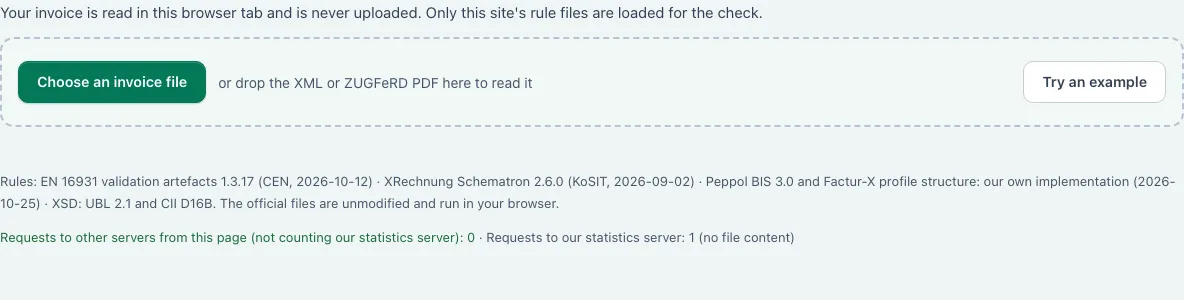
Choose the XML file or drop it on the page. You get three views: the invoice as on paper, the validation report with each finding, and the raw XML. Above them the Peppol ID block shows the electronic address of the seller (BT-34) and of the buyer (BT-49).
The tool runs in your browser tab and nothing is uploaded; the page shows how many requests went to other servers (0). It is free and needs no account.
At a glance
The Peppol & UBL invoice viewer opens a UBL 2.1 invoice or credit note in the browser, shows it as a readable invoice, checks it against EN 16931 and the Peppol BIS Billing 3.0 rules, and checks the Peppol IDs of seller and buyer.
- Peppol BIS Billing 3.0 is a CIUS of EN 16931 for UBL invoices and credit notes; its current release is the May 2026 release.
- Checks run with UBL 2.1 XSD, the EN 16931 validation artefacts 1.3.17 and our own implementation of the Peppol rules, written from the published specification.
- A Peppol ID is a scheme code from the EAS code list plus an identifier, for example 0088:5790000436101; the page checks scheme, format and, where public, the check digit without any request.
- The file is not uploaded; the page counts requests to other servers and shows 0.
Sources: Peppol BIS Billing 3.0 (checked 2026-11-11) · Peppol Directory (checked 2026-11-11) · EN 16931 validation artefacts 1.3.17 (CEN/TC 434) (checked 2026-11-11)
How to open and check a Peppol or UBL invoice
- Click Choose an invoice and select the XML file, or drop it on the field.
- To see how it works first, click Try an example. It loads a fictitious Dutch Peppol BIS invoice.
- Read the Invoice tab: seller, buyer, invoice number, dates, lines, VAT breakdown, totals, payment details and attachments.
- Open the Report tab: every finding with its rule ID and the place in the XML.
- Read the Peppol ID block: the scheme code, whether it is on the EAS list, whether the number has the right format and, for some schemes, whether the check digit is correct.
- Use Print / save as PDF for a PDF copy of the readable invoice, or Copy report for the report as text.
What do I do when the report shows errors?
An error means the file breaks a rule of the XML schema, of the European standard EN 16931 or of Peppol BIS Billing 3.0. Each finding names its rule ID, for example BR-CO-15, and the place in the XML. Send that line to the sender of the invoice or to the support of the invoicing software that made it. The page only reads your file; it does not change it.
What is Peppol BIS Billing 3.0?
Peppol BIS Billing 3.0 is a specification for invoices and credit notes in UBL. It is a CIUS, a “core invoice usage specification”, of the European standard EN 16931: it takes the EN 16931 data and adds its own rules, so a Peppol invoice is also an EN 16931 invoice. Two identifiers in the file name it: the CustomizationID urn:cen.eu:en16931:2017#compliant#urn:fdc:peppol.eu:2017:poacc:billing:3.0 and the ProfileID urn:fdc:peppol.eu:2017:poacc:billing:01:1.0. The endpoint ID of seller and buyer needs a scheme ID.
What is a Peppol ID and what format does it have?
A Peppol ID (participant ID) says who can receive documents in the network. It has two parts: a scheme code from the EAS code list, and the identifier of the company in that scheme. Written together: 0088:5790000436101. In the Peppol network the same ID is written iso6523-actorid-upis::0088:5790000436101. Examples of schemes are 0088 (GS1 GLN, 13 digits), 0208 (Belgian KBO/BCE number, 10 digits), 0204 (German Leitweg-ID) and 9925 (Belgian VAT number).
The viewer checks, without any request: that the scheme code is on the EAS list (the list behind rule BR-CL-25 in the EN 16931 rules shipped with the site), that the identifier has the format of that scheme, and, for GLN, the Belgian KBO number, SIREN and the Swedish organisation number, that the check digit is correct. For other schemes only the list is checked. It cannot tell whether the company is registered in the network.
How do I find a company in the Peppol Directory?
The Peppol Directory is the public search for registered participants. Next to each ID the viewer shows a link “Look up in the Peppol Directory”. The link opens the search with the ID filled in, in a new tab. The ID is sent to the Directory only when you open the link; the viewer itself makes no request.
What does the validation cover?
The XML is checked against the UBL 2.1 schema, the EN 16931 validation artefacts 1.3.17 and our own implementation of the Peppol rules (PEPPOL-EN16931, PEPPOL-COMMON and the German, Dutch and Italian national rules), written from the published specification. Not run: the Danish, Swedish, Norwegian, Icelandic and Greek national rules and a few Italian identifier checks. The result is a technical check, not tax or legal advice.
Frequently asked questions
What is Peppol BIS Billing 3.0?
It is the Peppol specification for UBL invoices and credit notes, a CIUS of EN 16931. Its current release is the May 2026 release.
What is a Peppol ID and what format does it have?
A scheme code from the EAS list plus an identifier, for example 0088:5790000436101 for a GS1 GLN. The format of the identifier depends on the scheme. The viewer checks scheme, format and, where there is a public algorithm, the check digit.
How do I find a company in the Peppol Directory?
Use the “Look up in the Peppol Directory” link next to the ID in the result. It opens the Directory search with the ID filled in.
What is UBL, and where can I get a UBL invoice example?
UBL is an OASIS XML standard; UBL 2.1 is one of the two syntaxes of EN 16931 (the other is UN/CEFACT CII). Click Try an example to load a fictitious Peppol BIS Billing 3.0 invoice and look at it in all three views.
Is a Peppol invoice the same as an EN 16931 invoice?
A Peppol BIS Billing 3.0 invoice is an EN 16931 invoice with extra Peppol rules, so it passes the EN 16931 rules and the Peppol rules. An EN 16931 invoice is not automatically a Peppol invoice: it also needs the Peppol identifiers and the Peppol rules.
Can I turn a UBL invoice into a PDF?
You can print the readable invoice and choose “Save as PDF” in the print dialog. The page does not make a PDF/A-3 with the XML attached; for XRechnung there is a German page for that, XRechnung in PDF umwandeln.
Is my invoice uploaded?
No. The file is read in your browser tab. Requests to our own statistics server are counted on a separate line and never contain the file content.
Related tools
- Electronic invoice viewer — Open any e-invoice: the format is detected for you
- P7M Viewer: open a .p7m file online — Open a .p7m file and read its signer details
- KSeF in Poland: dates, FA(3), UPO and a viewer — KSeF dates, FA(3) and UPO explained, plus a KSeF XML viewer
- What is e-invoicing? — E-invoice explained: formats, mandate dates, viewer